-
Talk to Our Care Planner

What Is Overnight Care for Elderly Loved Ones and What Does It Cost?
When your aging parent or loved one starts needing help at night, it can feel like the ground shifts under your feet. You know something has to change, but you’re not sure what that should look like.
Are they safe at night? You should probably consider an overnight caregiver. This is where overnight care for elderly loved one’s steps in.
Overnight care is really about safety, peace of mind, and making sure your loved one has someone they can count on when you can’t be there.
Let’s break it all down, so you know what this type of care involves, how much it costs, and whether it might be right for your family.

What Is Overnight Care for Elderly? What Overnight Caregivers Actually Do
An overnight caregiver is there to assist with anything that might happen between bedtime and morning. Stop picturing someone sitting in the living room scrolling their phone all night, that’s not what overnight home care is.
Overnight care could mean helping your parent get to the bathroom. It could mean repositioning them in bed to avoid bedsores. It could be changing wet clothing, refilling water, calming someone down after a nightmare, or helping with early-morning meds.
These duties are part of a broader category of support known as personal care services, which are fundamental to keeping loved ones comfortable and safe.
Some caregivers stay fully awake. Others are allowed to sleep lightly, depending on the agreement and needs of the client.
For seniors with dementia, it’s a whole different story. Overnight caregivers prevent wandering, guide confused elders back to bed, and provide gentle reassurance when the world feels strange and overwhelming.
Sundowning is real, and it often peaks in the late evening. A calm, trained presence can keep your loved one safe and help you rest easy.
For more in-depth information on managing the unique challenges of dementia and Alzheimer’s, explore our dedicated resources on dementia and Alzheimer’s care.
There’s also the companionship factor. Many older adults simply don’t want to be alone at night. Knowing someone is nearby can help them sleep better and feel less anxious. This essential emotional support is a core part of what companion care is.
The Two Types of Overnight Care

Here’s something a lot of people don’t know. There are two types of overnight care for seniors.
Awake overnight care means the caregiver stays awake and alert all night. This is ideal for seniors with dementia, fall risks, or serious medical conditions.
Sleep shifts or on-call care means the caregiver is allowed to sleep during quiet periods but is expected to wake up and help if needed. This is more affordable, and it works well if your loved one just needs someone there for emergencies.
Knowing which type you need helps you figure out the right caregiver and the right pricing model.
Overnight Care for Elderly Cost: What You Can Expect to Pay
Let’s talk numbers, because overnight care for elderly cost is no small thing.
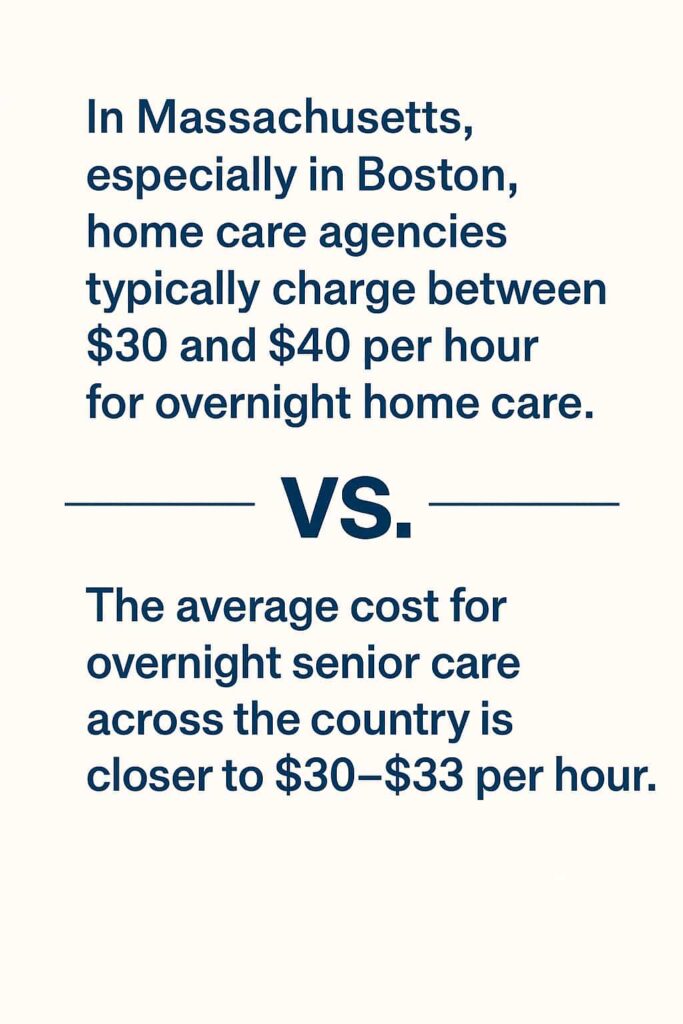
In Massachusetts, especially in Boston, this kind of care costs more than the national average. Home care agencies typically charge between $30 and $40 per hour for overnight home care.
If you’re hiring privately, the rate can drop to $20 to $30 per hour. That’s a big difference, but it comes with a lot of extra work and responsibility.
Let’s say you need help from 8 p.m. to 8 a.m. That’s 12 hours. At $35 an hour, that’s $420 per night through an agency. If you go with a flat overnight rate for sleep shifts, expect to pay between $150 and $250 per night, depending on how much the caregiver is expected to do.
For a more detailed breakdown of round-the-clock care expenses, including services that extend beyond just overnight, you might find our guide on 24/7 in home care cost very helpful.
If you’re wondering about the average cost for overnight senior care across the country, it’s closer to $30–$33 per hour. This figure is based on comprehensive national data, such as the Genworth Cost of Care Survey 2023, a reliable source for understanding long-term care expenses nationwide. Boston just happens to sit at the high end of that range.
Hiring an Agency vs. Going Private
Hiring an overnight caregiver through an agency means less hassle for you. The agency handles background checks, payroll, scheduling, and insurance. If your caregiver calls out, they send a replacement.
But all that convenience comes with a price. Not only is the hourly cost higher, but the caregiver might only receive half of what you pay. You’re paying for the whole system.
When you hire someone privately, you’re the boss. That means you manage taxes, liability, and scheduling. You can save money, but it’s more work, and if something goes wrong, you’re on the hook.
To understand these potential pitfalls fully, read more about the risks of hiring a private caregiver.
Families in Boston who’ve gone the private route often find great caregivers by word of mouth or through local senior centers. If you are specifically searching for hiring professional caregivers in Boston, this local resource can guide your search.
Still, many choose agencies for peace of mind, even if it costs more.
When Overnight Home Care Makes Sense
Overnight care for elderly folks is not for everyone. But it’s absolutely life-changing for families dealing with issues like:
- Dementia or Alzheimer’s, especially if sundowning is an issue
- Frequent bathroom trips or incontinence
- Recent falls or injuries
- Late-night anxiety or confusion
- Sleep disorders or night wandering
- Recovery after surgery
If you’ve found yourself searching for “overnight care for elderly near me,” it probably means you’re already overwhelmed. You may be doing a lot of the caregiving yourself, and something has to give.
Other Costs and Hidden Details of Overnight Care

Agencies may have minimum shift lengths. Many require 8, 10, or 12-hour blocks for overnight care. That means even if you only need 4 or 5 hours, you may have to pay for the full shift.
If you hire privately, you can sometimes negotiate shorter shifts or different setups, but fewer caregivers will commit to part-time overnight hours.
Also, don’t assume all caregivers are allowed to sleep. Many families wonder, “do overnight caregivers sleep?” It depends. In awake shifts, no. In sleep shifts, maybe. You need to agree on expectations upfront. For a deeper dive into these different arrangements and what to expect, the article ‘Can Overnight Caregivers Sleep?‘ offers valuable insights.
Does Medicare Pay for Overnight Care at Home?
In most cases, no. Medicare does not pay for overnight care at home unless it’s part of a skilled nursing plan prescribed by a doctor. Overnight home health care is usually considered non-medical support, and Medicare does not cover non-medical custodial care.
This is because overnight care often falls under the umbrella of what is called non-medical home care, which focuses on personal care and companionship rather than skilled medical services.
To better understand the difference between the daily support provided by caregivers and more medically focused services, you might find our explanation of home care versus home health care illuminating.
There are a few exceptions, especially if your loved one is on hospice care, but for most families, overnight care for elderly loved ones is paid out of pocket.
How to Choose the Right Overnight Caregiver

If you’re going private, ask for references. Do a background check. Clarify duties. Discuss pay and expectations before the first shift.
If you’re using an agency, ask what happens if your regular caregiver calls out. Ask if the overnight caregiver rates are fixed or vary by night of the week.
Ask what kind of training the aides receive and whether you can meet them in advance. Understanding the different certifications and roles, such as the differences between a PCA versus an HHA, can help you assess the qualifications of potential caregivers.
And don’t forget to ask this important question: “how much do caregivers charge for overnight?” Some families assume the price will be the same as daytime rates. It’s not.
Overnight Care Is a Lifeline
This kind of care isn’t cheap. It takes planning. But for many families, it’s the only way to keep a loved one safe at home.
You get peace of mind. Your loved one gets comfort, security, and dignity. And if you find the right caregiver, they’ll feel like part of the family.
So if you’re waking up exhausted, if your parent is calling you in the middle of the night, or if you just want to stop worrying every evening, know this.
Need More Help?
If you’re looking for trusted overnight home care for seniors in Massachusetts, speak with local agencies like Global One Home Care and compare a few.
Whether you’re considering overnight respite care for seniors or long-term help, you deserve a setup that truly works for your family.

Dr. Ella Njike is the branch administrator for Global One Home Care, Boston, an agency that provides quality care for seniors and kids or adults with disabilities. With a Doctorate and extensive experience working in the healthcare industry, Dr Ella brings a unique understanding to the challenges families face. Through Global One Home Care Boston, he ensures that care extends beyond daily tasks, focuses on building genuine connections and respecting each family's journey.
Contact us
We aim to be an active partner in your care, not to take over. You are the CEO of your care, and we support you in managing it effectively.
Here are some features of our Global One Home Care
- 24/7 access to care
- Customized care plans
- Supervisory visits
- Caregiver introductions
- Nutritional planning
- Respite support
- Companionship
- Mobility assistance
- Durable Medical Equipment recommendations
- Errands and Shopping
- Fall Prevention
- ADLs